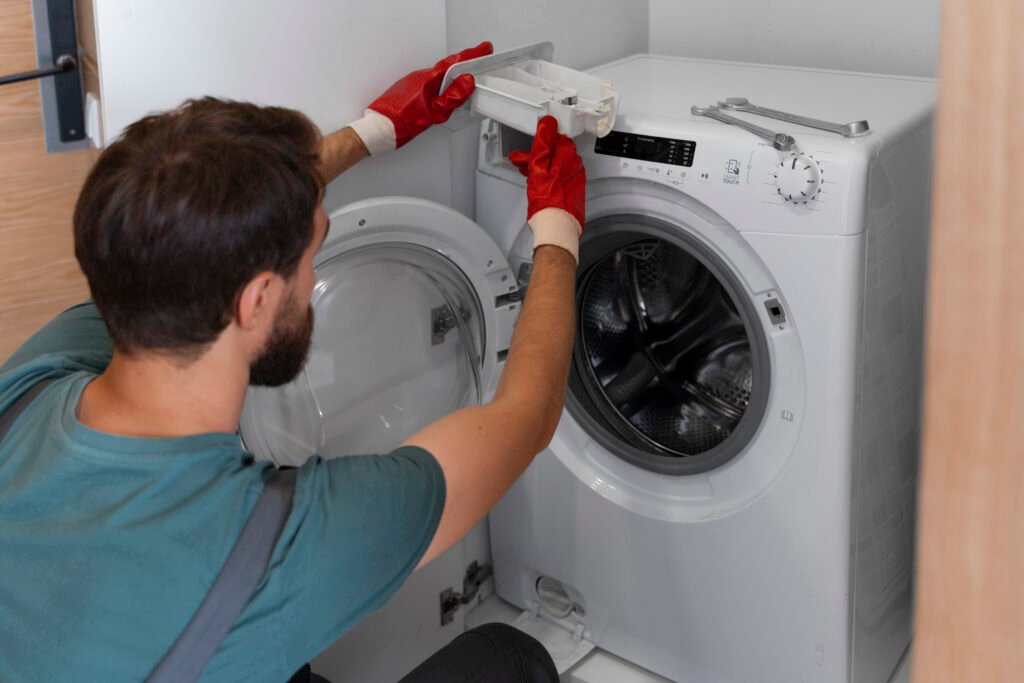
Your washing machine stops mid-cycle, or it starts making a noise you have never heard before, and the first thing you want is a straight answer. Not a sales pitch. Just: what’s wrong and what will it cost to fix?
Washing machine repair in Dubai comes with a few wrinkles that generic repair guides never mention, because they are not written for this city. Dubai runs its washers on 220-240V at 50Hz, which is not universal. Water here is hard, loaded with dissolved minerals that most of the world’s washing machines were never calibrated for. And a large share of the machines running in Dubai homes were bought somewhere else, by someone else, before the property changed hands.
This guide covers what actually breaks, why it breaks here specifically, and what quick response charges are to fix it. No inflated call-out fees, no vague “it depends” pricing. Just the numbers.
Why Washing Machine Repair in Dubai is Different
Two things separate a Dubai breakdown from one in London or Toronto: the water and the electricity.
Hard water is quietly wrecking your machine
Dubai’s tap water, largely produced through desalination and then blended, still carries a moderate-to-high mineral load depending on the emirate’s supply network and building storage tank condition. Limescale builds up inside the heating element, the drum bearings, and the water inlet valve. A washer that’s three years old in Dubai can show the same scale buildup you’d expect from a ten-year-old machine in a soft-water region.
The heating element is usually the first casualty. Scale coats it like a layer of plaster, and the element has to work harder to reach the same water temperature. Eventually it cracks or burns out entirely. If your machine takes twice as long to run a cycle or your energy bill has crept up without an obvious reason, that’s often limescale, not age.
Voltage mismatch on imported machines
Here’s the one nobody talks about. Plenty of Dubai households inherit appliances from a previous tenant, buy secondhand from expat move-out sales, or bring a washer over from a home country with a different electrical standard. A machine built for 100-127V (common in North America, parts of Japan) running on Dubai’s 220-240V supply will not just underperform. It can blow the control board, fry the motor windings, or, in the worst cases, become a fire risk.
Before booking a repair on a machine you didn’t buy locally, check the rating plate inside the door or on the back panel. If it doesn’t list 220-240V compatibility (sometimes shown as a dual range), that’s not a repair job. That’s a replacement conversation and worth flagging honestly rather than pouring good money into a machine that was never meant to run here.
Frequency matters too
Less commonly discussed: some markets run appliances on 60Hz, while the UAE grid runs at 50Hz. Motors designed around 60Hz timing can run slightly slow, generate extra heat, or wear their bearings faster on a 50Hz supply. It’s a smaller factor than the voltage issue, but it adds up, especially on older analog-timer machines rather than newer inverter models that adapt automatically.
DEWA supply and voltage stability
Dubai Electricity and Water Authority delivers a stable grid overall, but voltage sag during peak summer load (when every AC unit in the building is running flat out) is a real, documented phenomenon. Washing machines with electronic control boards are more sensitive to this than older mechanical-timer units. If your machine’s display resets mid-cycle or the control panel occasionally freezes, a voltage stabiliser plug can solve it for less than a repair would cost.
Common Washing Machine Problems in Dubai and What Causes Them
The machine won’t drain
This is the single most frequent callout. Causes range from a blocked drain filter (the cheapest fix) to a failed drain pump or a kinked, sagging drain hose. Lint, hair, coins, and, in Dubai specifically, fine sand and dust that get tracked in on clothing and shoes all collect in the same filter housing over time.
Fix it yourself first: locate the small access panel at the bottom front of the machine, place a shallow tray underneath, and unscrew the filter cap slowly. If that clears the blockage, you’ve saved yourself a callout. If water still won’t drain, the pump itself may have failed, and that needs a technician.
Excessive vibration or a machine that “walks”
If your washing machine moves across the floor during the spin cycle, the problem is almost always one of three things: unbalanced load, uneven floor, or worn-out shock absorbers/suspension springs. In villas with tiled utility rooms that were never perfectly levelled during construction, this is more common than people expect. A technician can adjust the levelling feet in minutes, but if the suspension components are worn, they need replacing.
The drum won’t spin, or clothes come out soaking wet
Usually a broken or slipped drive belt, a failed motor, or a door lock mechanism that isn’t engaging properly (many machines refuse to spin if the door sensor thinks the door is open). Belt replacement is a quick, low-cost fix. Motor failure is the expensive end of this problem.
Water leaking from the machine
Door seal gaskets degrade with age and with exposure to certain detergent residues. In Dubai’s climate, rubber components can also dry out and crack faster than in cooler, more humid regions when machines are installed in enclosed, poorly ventilated utility cupboards that trap heat. Check the door seal for tears first. Hose connections at the back are the second most common leak point and are often just a matter of tightening or replacing a worn washer.
Persistent bad smell from the drum
This is a mould and bacteria issue, not a mechanical fault, and it’s extremely common in front-loading machines run mostly on cool, quick cycles (which many Dubai households do to save on both time and electricity). Running an empty hot cycle with a cleaning tablet once a month and leaving the door ajar between washes prevents most of it. If the smell persists after cleaning, the rubber door gasket may be trapping standing water and needs a deeper clean or replacement.
The machine won’t turn on at all
Check the power supply and socket first; a tripped circuit breaker is common, especially in older villas where a single circuit serves multiple laundry-room appliances. If the socket tests fine, the issue is likely the control board, a wiring fault, or, in imported machines, exactly the voltage mismatch problem covered above.
Front-Load vs. Top-Load: Does It Change the Dubai Repair Picture?
Most new-build apartments across Dubai come fitted with front-load machines, since space is tighter and stacking with a dryer is common in smaller utility nooks. Villas, especially older ones in areas like Jumeirah or Al Barsha, are more likely to have a top-load machine inherited from a previous layout or installed for ease of use with domestic help.
Front-load machines are more exposed to the mould and gasket problems described above, because the door seal sits directly in the path of standing water. They are also more sensitive to unlevel floors since the drum spins on a horizontal axis, and any tilt throws the whole mechanism off balance during high-speed spins. Top-load machines skip the gasket problem almost entirely but tend to use more water per cycle, and in older agitator-style units, the drive mechanism at the base wears out in a way that’s rarely worth repairing once it starts.
Neither style is more or less prone to the two Dubai-specific issues covered above, hard water scaling and voltage mismatch. Those two problems don’t care what door the machine has. What matters more is how the machine was sourced. A top-load machine bought new from a Dubai retailer, whatever the brand, will be rated correctly for the local grid. A front-load machine shipped over in a container from an expat’s previous posting is the one worth checking twice.
What Happens During a Repair Visit
A quick-response technician arrives with a standard diagnostic kit and starts the same way every time, regardless of the reported symptom. First, the power supply and voltage at the socket. Then the drain filter and hoses. Then a short test cycle if the machine powers on at all. This first pass catches the majority of common faults, filter blockages, loose hoses, and tripped circuits within the first fifteen minutes.
If the issue turns out to be electrical or tied to the control board, the technician explains what’s failed and what part replacement involves before proceeding. That’s the point where cost can shift from the flat AED 119 rate to a rate-plus-parts quote. You’re told the number before anything is opened up further, not after. For machines showing the telltale signs of a voltage mismatch, arcing marks near the power inlet, a scorched smell, or a visibly discoloured control board, the technician flags it directly rather than attempting a repair that won’t hold.
Most standard repairs, drainage, belts, door seals, and levelling get finished in a single visit lasting anywhere from 45 minutes to two hours. Parts that need sourcing, an uncommon control board for an older imported model, for instance, may require a short return visit once the part arrives. That gets communicated at the point of diagnosis, not as a surprise later.
Washing Machine Repair Costs in Dubai (2026 Pricing)
Pricing across Dubai’s repair market varies widely, and third-party estimates for washing machine repair in the city typically range from around AED 100 for a simple filter clean-up to AED 700 or more for motor or control board replacement, with several providers quoting AED 200-800 as a general band depending on parts and labour. That range is useful context, but it isn’t what you’ll pay with quickresponse.
quickresponse runs on a flat, published rate card rather than a variable quote that depends on who answers the phone that day.
| Service | Price (AED) |
|---|---|
| Washing machine repair & maintenance (diagnosis + standard repair) | 119 |
| Hourly handyman/electrician/plumber rate (for related electrical or plumbing work) | 99 |
| 4-hour half-day call-out (if extended work is needed) | 349 |
| 8-hour full-day call-out (major installation or multi-appliance jobs) | 639 |
The AED 119 rate covers the standard washing machine repair and maintenance visit, including diagnosis and the fix for the majority of common faults: drainage issues, belt problems, door seal inspection, and control board diagnostics. If your machine needs a specific part that has to be sourced (a replacement motor or a hard-to-find control board for an older imported model), that part cost is separate and quoted upfront before any work begins. There are no surprise callout fees layered on top once a technician is already in your home.
Repair or Replace? A Straight Answer
The general rule used across the appliance repair industry, and one that holds up in Dubai too, is this: if the repair cost is likely to exceed 40-50% of the price of a comparable new machine, replacement usually makes more financial sense, particularly if the machine is already past the 8-10 year mark.
Where this gets Dubai-specific: if your washing machine has a voltage or frequency mismatch with the local 220-240V/50Hz supply, no amount of repair spending is a permanent fix. You’re not solving the underlying issue; you’re managing symptoms until the next component fails. In that scenario, replacement with a locally compliant machine is the honest recommendation, even if the current fault looks minor and cheap to patch.
Preventing Repeat Breakdowns in Dubai’s Climate
A few habits genuinely extend a washing machine’s working life here, more than generic maintenance advice suggests, because they respond to local conditions specifically.
Run a hot maintenance cycle with a descaling tablet monthly. This matters more in Dubai than in soft-water regions because of the mineral load discussed earlier. Leave the door and detergent drawer open between washes so trapped moisture can evaporate instead of breeding mould in the door seal. If your machine is installed in an enclosed cupboard or utility closet with no ventilation, that heat buildup shortens the life of rubber seals and electronic components alike; a small vent or gap in the door helps considerably. And if you’ve bought or inherited a secondhand machine, check the voltage rating plate before you plug it in for the first time, not after something burns out.
How much does washing machine repair cost in Dubai?
With a quick response, standard washing machine repair and maintenance is a flat AED 119, covering diagnosis and the fix for most common issues. Third-party market rates across Dubai range more broadly, roughly AED 100 to AED 800+, depending on the provider and the specific fault.
Why do washing machines break down faster in Dubai than in other countries?
Two main reasons: hard water causes limescale buildup inside heating elements and valves faster than in soft-water regions, and machines imported from countries with different voltage or frequency standards (particularly 100-127V markets) are running outside their designed electrical range on Dubai’s 220-240V, 50Hz supply.
Can I use a washing machine bought in the US or Japan in my Dubai apartment?
Only if it’s rated for 220-240V, which most standard US and Japan-market machines are not, since those markets typically run 100-127V. Running an incompatible machine on Dubai’s supply risks the motor and control board and is not a safe long-term setup, regardless of what a step-down converter claims to solve.
Why does my washing machine smell bad even after cleaning it?
Standing water trapped in the door seal gasket is the usual cause, especially in machines run mostly on cool, short cycles. A monthly hot cycle with a descaler, plus leaving the door open between washes, resolves most cases. If the smell persists, the gasket itself may need replacing.
Is it worth repairing an old washing machine in Dubai?
If the repair cost stays under roughly 40-50% of a new machine’s price and the fault isn’t tied to a voltage mismatch, yes. Once you’re looking at motor or control board replacement on a machine past 8-10 years old, replacement is usually the more sensible route.
Does QuickResponse repair all washing machine brands in Dubai?
Yes, quickresponse technicians handle all major brands, including Samsung, LG, Bosch, Siemens, and Whirlpool, along with less common imported models, with the same flat AED 119 diagnosis-and-repair rate.
How quickly can I book a washing machine repair in Dubai through QuickResponse?
Bookings are handled through the QuickResponse platform with same-day slots available in most Dubai areas, subject to technician availability at the time of booking.
Does hard water damage matter more in a villa or an apartment?
Villas with their own rooftop water tanks often see more mineral buildup than apartments on a direct building supply, since water sits longer in storage tanks that trap sediment and heat. If your villa’s tank hasn’t been cleaned in over a year, that’s frequently a bigger factor in a struggling washing machine than the machine’s age. Ask your technician to check the tank supply pressure and condition alongside the appliance itself, since the two issues often show up together.
Leave a Reply