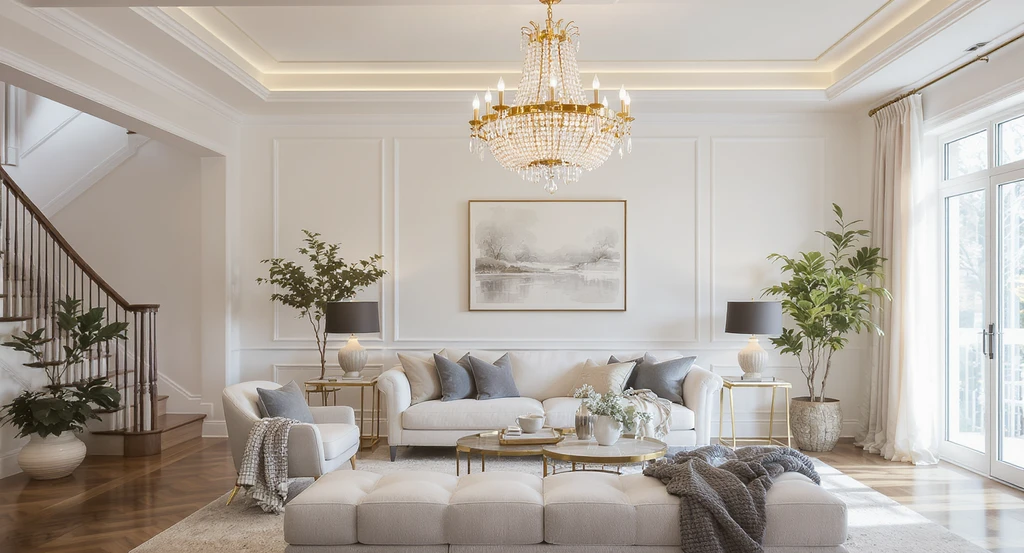
Choose the Perfect Chandelier for Your Dubai Home in 2026
Picking a chandelier for your Dubai home starts long before you scroll through a lighting catalogue. Most guides jump straight to size charts and finishes, the same advice you’d get for a home in London or Toronto. Dubai ceilings don’t work that way. What holds a 12 kilogram crystal piece safely in a concrete-slab apartment in Downtown Dubai can rip clean through a gypsum board ceiling in a JBR tower, and a chandelier that looks stunning in a showroom can corrode within eighteen months on a Marina-facing balcony corridor. Getting a chandelier for your Dubai home right means working backward from your ceiling, your building type, and your electrician, not forward from a photo you liked on Instagram.
To choose the perfect chandelier for your Dubai home, you need a clear framework, not just a catalogue scroll. This guide walks through the decisions that actually matter here: ceiling structure, weight capacity, wiring compliance, material behaviour in Dubai’s climate, and how villa layouts differ from apartment towers. We’ll also cover what installation should cost and why the person hanging your chandelier matters almost as much as the fixture itself.
Start With the Ceiling, Not the Chandelier
Before you choose the perfect chandelier for your Dubai home, you need to understand what’s holding up your ceiling. Every chandelier guide written for a generic Western market assumes a joist-and-drywall ceiling with a standard electrical box rated for fixture weight. Dubai apartments and villas are built differently, and that difference decides what you can safely hang overhead.
Most Dubai apartment towers use reinforced concrete slab ceilings, often post-tensioned. Post-tension slabs contain steel cables under tension running through the concrete, and drilling into the wrong spot can sever a cable, compromise the slab’s structural integrity, or trigger a serious safety incident. Any anchor point for a chandelier in a post-tension building needs to go through the original junction box or a location cleared by a structural assessment, never a random drill point chosen because it looks central.
Layer on top of that slab is often a gypsum board or POP (plaster of Paris) false ceiling, installed for aesthetics or to hide MEP ductwork and district cooling fan coil units. A false ceiling on its own cannot support chandelier weight. Gypsum board holds maybe two or three kilograms before it starts to sag or crack, nowhere near enough for a multi-tier crystal or metal piece. The chandelier has to anchor into the concrete slab above, with the false ceiling cut to let the fixture pass through, or into a reinforced mounting plate installed specifically for that purpose.
Villa ceilings need their own checklist if you choose the perfect chandelier for your Dubai home there. Villas, particularly older ones and those with double-height majlis or foyer ceilings, sometimes use timber trusses or lighter block construction rather than solid concrete. These need their own load assessment, and a majlis ceiling running four to six metres high adds rigging and access considerations that a standard living room job doesn’t have.
Before you fall for a design online, find out what’s actually above your head. A technician can check this in minutes during a home visit, and it should happen before you commit to a fixture, not after it arrives at your door.
Weight Limits and Mounting Hardware
Weight is the first number to check when you choose the perfect chandelier for your Dubai home. Once you know your ceiling type, weight becomes the next filter. Chandelier weight in Dubai homes typically falls into three rough bands: under 5 kilograms for simple pendant-style or single-tier fixtures, 5 to 15 kilograms for mid-size crystal or multi-arm pieces, and above 15 kilograms for statement chandeliers meant for double-height spaces.
A standard ceiling junction box, the kind wired during initial construction, is usually rated to hold light fixtures up to around 23 kilograms when properly anchored into the slab. Anything heavier, particularly oversized tiered crystal designs or cascading fixtures popular in majlis rooms, needs a dedicated mounting bracket fixed with structural anchors rather than relying on the junction box alone.
This is where many buyers get burned. A supplier will happily sell an 18-kilogram statement piece without ever asking what’s holding up your ceiling. Ask for the fixture’s exact weight before ordering, not an estimate, and pass that number to whoever installs it so they can confirm the mounting method matches the load. A chandelier that comes loose months after installation is rarely a manufacturing defect. It’s almost always a mismatch between weight and anchor point that nobody checked at the start.
Multi-tier crystal chandeliers deserve extra scrutiny here because their listed weight often excludes chains and ceiling canopy hardware. A retailer quoting 9 kilograms for the fixture itself might hand you an installed weight closer to 12 once the chain length and canopy are factored in. Ask specifically for the installed weight, not the boxed weight, before you assume a standard junction box will hold it.
Material Choices That Actually Hold Up in Dubai’s Climate
Material matters just as much as size when you choose the perfect chandelier for your Dubai home. Chandelier retailers here love talking about shell, bead, and natural-fibre trends, and those looks do suit Dubai’s warmer interior palettes. But climate durability gets far less attention than it should, and it’s the difference between a fixture that looks the same in three years and one that needs replacing.
Coastal exposure is a big factor if you choose the perfect chandelier for your Dubai home near the marina. Coastal buildings in Dubai Marina, JBR, and Palm Jumeirah deal with salt-laden air that accelerates corrosion on untreated metal finishes. A brass or gold-tone chandelier without a protective coating can start pitting or discoloring within a year in a unit with balcony access facing the water, even with regular AC use indoors. Look for powder-coated or lacquered finishes rated for coastal exposure if your unit sits within a few hundred metres of the marina or beach, and avoid raw brass or untreated iron for anything near an entryway or balcony-adjacent ceiling.
Inland, the bigger threat is dust. Sandstorms deposit fine particulate that settles into open crystal arrangements and beaded designs, and it builds up faster in units with balcony doors or windows opened regularly. Sealed or semi-enclosed fixtures collect less of it, and materials like treated wood or powder-coated metal wipe clean far more easily than delicate faceted crystal, which needs careful dusting to avoid scratching.
Constant air conditioning actually works in your favour for organic materials. Shell and natural-fibre chandeliers stay dimensionally stable in climate-controlled apartments because humidity swings are minimal indoors, even though Dubai’s outdoor humidity spikes heavily in summer. The risk shows up in villas with less consistent cooling zones, where natural materials can warp slightly near entry points that see more temperature fluctuation.
Matching Chandelier Style to Room and Ceiling Height
Style is the easy part once you choose the perfect chandelier for your Dubai home based on structure and material. Once structure and material are settled, style decisions get much easier. The standard sizing formula still applies as a starting point: add your room’s length and width in feet, and that sum in inches gives you a rough chandelier diameter. A 12-by-14-foot room points to roughly a 26-inch fixture. Over a dining table specifically, aim for a chandelier spanning half to two-thirds of the table’s width, hung so the bottom sits 75 to 90 centimetres above the tabletop.
Ceiling height is another reason to choose the perfect chandelier for your Dubai home room by room. Ceiling height changes the calculation more than most buyers expect. Standard Dubai apartment ceilings run 2.6 to 2.8 meters, which limits you to compact or flush-mount designs in most rooms, since anything with a long drop eats into headroom fast. Villa living rooms and double-height foyers, by contrast, often run 4 to 6 meters, and a small fixture disappears into that volume.
These spaces call for tiered or cascading chandeliers with enough visual weight to hold the room, and because they’re viewed from a seated position in majlis-style layouts, the drop length and light spread need to work for people looking up and across rather than straight ahead.
Open-plan living and dining areas common in newer Dubai developments benefit from a chandelier that reads well from multiple angles, since there’s rarely a single fixed viewing point the way there is in a boxed traditional dining room.
Why the Installer Matters as Much as the Fixture
The work doesn’t stop once you choose the perfect chandelier for your Dubai home; the installer matters just as much. This is the part nearly every chandelier retailer in Dubai glosses over. DEWA, the Dubai Electricity and Water Authority, requires that electrical work in residential properties be carried out by a DEWA-approved contractor employing technicians who hold a valid DEWA competency license. Installing a chandelier isn’t just hanging a decorative object. It’s connecting a fixture to a live circuit, and that circuit has to handle the load correctly, stay properly earthed, and meet the wiring standards DEWA enforces across the emirate.
Using an unlicensed installer carries real consequences beyond a shoddy-looking job. If a fire or electrical fault traces back to unauthorised work, home insurance can be voided, and the property owner, not just the installer, bears the liability. For anything beyond a simple like-for-like bulb swap, a DEWA-compliant technician should handle the connection, confirm the existing circuit can take the new fixture’s load, and check the junction box or mounting point is rated for the chandelier’s weight before it goes up.
If your chandelier requires a dimmer, that adds another compliance layer. LED chandeliers need a dimmer matched to the driver type inside the fixture, and mismatched dimmers cause flickering or premature LED failure. A qualified electrician will check compatibility before wiring it in rather than leaving you to troubleshoot flicker issues after the fact.
Villa vs Apartment: Choose the Perfect Chandelier for Your Dubai Home
Whether you choose the perfect chandelier for your Dubai home in a villa or an apartment, the mounting approach differs considerably. Apartment installations in Dubai tend to be more constrained and more standardised. Lower ceilings, existing junction boxes from the developer fit-out, and shared building management rules about what modifications residents can make to fixed installations are challenges. Most apartment chandelier jobs are straightforward: confirm the box rating, confirm the fixture weight, and install.
Villa installations carry more variables. Majlis rooms and double-height entryways often need scaffolding or lift access for safe installation, and older villas may have wiring that predates current DEWA standards, meaning the circuit itself needs an inspection before a heavier fixture goes in. Villa owners planning renovations that involve new circuits or a distribution board upgrade to support additional lighting should get DEWA inspection and sign-off as part of that work, not as an afterthought once the chandelier has already arrived.
Property type also affects how much freedom you have with statement pieces. Villa owners can generally go bigger and bolder in double-height spaces without worrying about a landlord’s fit-out restrictions, while apartment residents in a managed building sometimes need to check whether their fixture attaches through original developer wiring or if any structural work requires building management approval first.
Rental villas add one more layer worth checking before you buy anything. Tenants planning a chandelier swap should confirm with the landlord or property manager whether the existing fixture can be replaced outright or only supplemented, since some lease agreements require original fittings to be reinstalled at move-out. Keeping the original chandelier and its mounting hardware in storage avoids a dispute over the security deposit later.
Chandelier Installation Costs in Dubai
Pricing for chandelier work in Dubai typically covers three separate line items, and getting quoted a single flat number without a breakdown is usually a sign the quote is vague. A single chandelier installation, where an existing junction box is already in place and rated for the fixture, runs around AED 109. If new wiring is needed to reach the fixture location or an existing circuit needs modification to handle the load, that’s a separate wiring charge, typically starting around AED 119 depending on the run length and complexity. Chandeliers requiring dedicated switch installation or dimmer wiring add a further line item.
| Service | Approximate Cost (AED) |
|---|---|
| Single chandelier installation (existing junction box) | 109 |
| Wiring for new circuit or extended run | 119 |
| Switch or light point installation/replacement | 109 |
| Hourly electrician callout (general electrical work) | 99/hr |
Villa jobs involving majlis or double-height installations, scaffolding, or distribution board work will run higher than a standard apartment job because of access requirements and, in some cases, additional labour time. Always ask for an itemised quote listing labour, material brand (ABB, Legrand, and Siemens components are common standards here), and any DEWA certification fee separately, so you know exactly what you’re paying for before work starts.
Can I install a chandelier myself in my Dubai apartment?
Once you choose the perfect chandelier for your Dubai home, installation is the next question. Technically, you can hang a very light fixture onto an existing, correctly rated junction box, but any electrical connection work legally requires a DEWA-approved contractor. Beyond the legal requirement, DIY installation risks improper earthing, overloaded circuits, and voided home insurance if something goes wrong later
How do I know if my ceiling can support a heavy chandelier?
Before you choose the perfect chandelier for your Dubai home, get your ceiling checked. A licensed electrician or technician can assess this during a short home visit by checking whether you have a concrete slab ceiling with a properly rated junction box or a false ceiling that needs a separate mounting plate anchored into the structure above. Never assume a gypsum board ceiling alone can bear chandelier weight.
Does a chandelier need a special dimmer in Dubai homes?
LED chandeliers need a dimmer compatible with the driver built into the fixture. A mismatched dimmer causes flickering and shortens LED lifespan, so this compatibility check should happen at installation, not after the fixture is already wired in.
Are chandeliers suitable for both villas and apartments?
Absolutely — you can choose the perfect chandelier for your Dubai home whether you live in a villa or an apartment. Yes, but the mounting approach differs. Apartments generally use the existing developer-installed junction box if the fixture weight matches its rating. Villas, especially those with majlis or double-height ceilings, often need a dedicated structural assessment and sometimes scaffolding for safe installation.
How much does professional chandelier installation cost in Dubai?
Once you choose the perfect chandelier for your Dubai home, installation is the next line item to budget for. A standard installation using an existing junction box runs around AED 109. Additional wiring, new circuits, or dimmer switch installation are quoted separately based on the scope of work required.
Do coastal apartments need a different chandelier finish than inland ones?
Finish choice is part of how you choose the perfect chandelier for your Dubai home if you’re near the coast. Yes. Units in Dubai Marina, JBR, or Palm Jumeirah with regular balcony air exposure benefit from powder-coated or lacquered metal finishes that resist salt-air corrosion. Untreated brass or plain iron finishes tend to pit or discolour faster in these locations than the same fixture would inland.
Leave a Reply