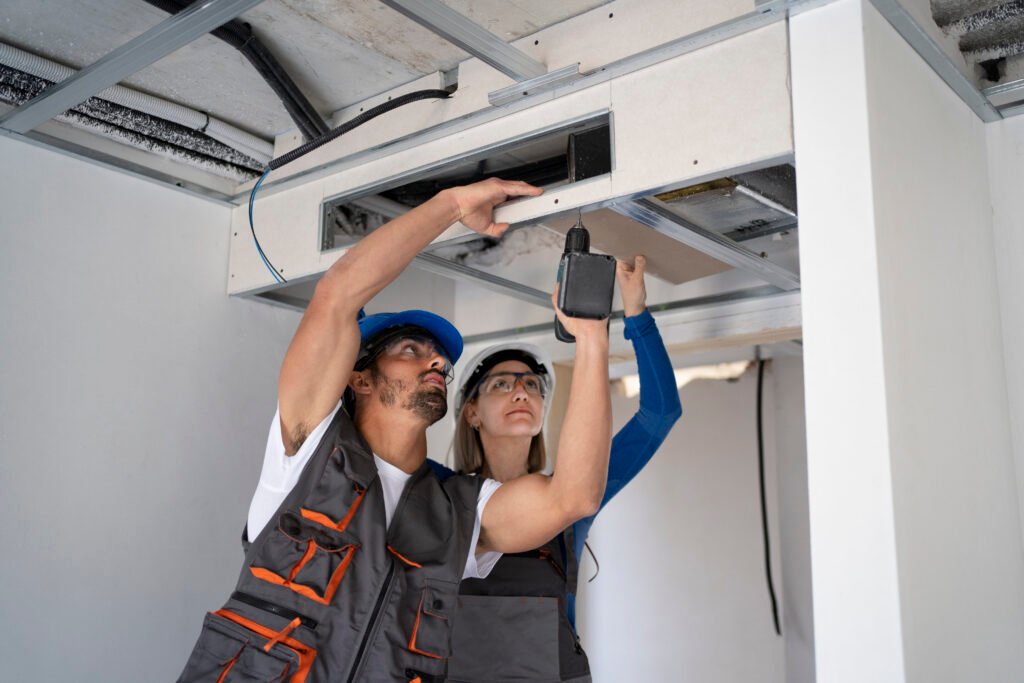
AC Repair vs Replacement in Dubai: Decide Wisely. Your AC just died for the third time this year. The technician is standing in your living room asking if you want it fixed again or replaced. You have about thirty seconds to make a call that affects your summer comfort and your bank account. This guide gives you a framework for that decision, built around how Dubai’s climate, DEWA tariffs, and a looming regulatory deadline change the AC repair vs replacement Dubai equation in ways generic advice doesn’t cover.
Most online guides hand you an age cutoff and call it done. That advice skips three things specific to Dubai. Sandstorm particulate clogs coils faster here than in almost any other climate. The cooling season runs 9 to 10 months, so your compressor barely gets a break. And there’s a 2030 deadline on R-22 refrigerant availability that can turn what looks like a routine repair into money down the drain. Here’s how to actually decide.
How Long Do AC Units Last in Dubai?
A split AC unit in Dubai typically lasts 10 to 15 years. That’s shorter than the 15 to 20 years you’d get in a milder climate, and the gap comes down to one thing: usage. A unit in London might run 3 to 4 months a year. A Dubai split unit runs close to 9 to 10, with the compressor cycling almost nonstop from May through September.
Three environmental factors shrink that lifespan further.
Sandstorm particulate gets into outdoor condenser coils and indoor filters at a rate most manufacturers never accounted for. Skip chemical coil cleaning for a year and you can lose 10 to 20 percent of cooling efficiency, based on service data from local providers. That loss forces the compressor to work harder, which wears down parts that weren’t built to compensate for it.
If you live near the coast, salt air is doing its own quiet damage. Dubai Marina, JBR, Palm Jumeirah. Salt-laden air corrodes condenser fins and electrical contacts faster than units further inland experience. Most repair-vs-replace guides written for other markets never mention this, but ask any technician who covers the Marina how often fan motors and coils come up for replacement there compared to inland villas.
Then there’s the water. Dubai’s hard water leaves mineral deposits in drain lines, and over years, in coil components exposed to condensate. Combine that with humidity-driven mould in a poorly maintained unit and you get failure points that simply don’t show up in drier climates.
So if your unit is past the 10-year mark, sits near the coast, or hasn’t had consistent professional maintenance, treat the lower end of that lifespan range as your realistic ceiling. Not the upper end.
AC Repair vs Replacement in Dubai Decision Framework
Three numbers matter more than anything else here: the age of your unit, the cost of the repair, and the cost of a comparable new unit.
The 50 Percent Rule
If a repair quote exceeds 50 percent of the cost of a new, comparable unit, replacement is almost always the better financial call. A 1.5-ton inverter split installed new in Dubai runs roughly AED 2,400 to 3,800 (third-party pricing, verify against current quickresponse rates before quoting customers). Say your repair estimate comes back at AED 1,800 on a unit that would cost AED 3,200 to replace. That’s 56 percent. Replace it.
Age Brackets That Actually Matter
Under 5 years old, repair almost always makes sense. The exception is external damage or a manufacturing defect still under warranty. At this age, a compressor or coil failure is rare, not a sign the unit is wearing out.
Between 5 and 10 years, repair if the cost sits below 40 to 50 percent of replacement cost and the unit has a clean maintenance history. A clogged drain line or a failed capacitor on a 6-year-old unit is a quick fix. A second compressor failure on that same unit within this window tells a different story.
Over 10 years old is where most Dubai homeowners get the call wrong. A major repair at this age, a compressor, both coils, a control board, often buys you one or two more years before the next failure shows up. At that point you’re financing a unit that’s already depreciated past usefulness. Run the math on a new, efficient unit instead.
The Three-Repair Rule
Three separate repairs within twelve months, even if each one was cheap on its own, means it’s time to replace. The pattern itself is the signal. A unit failing repeatedly isn’t unlucky. It’s telling you the remaining components are reaching end of life together, and you’ll be back here in a few months regardless of which part gets fixed this time.
What a Repair Actually Costs in Dubai (2026 AED Ranges)
These figures come from third-party Dubai service data. Verify against quickresponse’s live pricing before publishing or quoting customers.
| Repair Type | Estimated AED Range |
| Diagnostic visit (no fix) | 150 – 250 |
| Gas top-up (R-22 or R-410A) | 250 – 450 |
| Leak detection, repair and regas | 600 – 1,200 |
| Capacitor or contactor replacement | 150 – 600 (plus labour) |
| Fan motor replacement | 350 – 900 |
| Compressor replacement | 1,500 – 4,000 |
| Indoor or outdoor coil replacement | 800 – 2,500 |
| Drain line clearing | 200 – 500 |
A top-up or capacitor swap is cheap and usually the right call on a younger unit. Compressor and coil replacement sit close enough to the cost of a full new unit that you need to run the 50 percent rule before agreeing to either.
What a New AC Unit Costs in Dubai (2026 AED Ranges)
| System Type | Estimated AED Range |
| 1.5-ton split, supply and install | 2,400 – 3,800 |
| 2-ton split, supply and install | 3,200 – 4,800 |
| Central AC FCU swap | 3,500 and up |
| Full villa ducted system | 15,000 – 40,000+ |
Premium brands like Daikin and Mitsubishi sit at the higher end of each range. Budget and mid-tier brands such as Midea, TCL, and Super General sit lower. Every figure here needs verification against quickresponse’s current supplier rates before it goes live anywhere customer-facing.
The DEWA Bill Factor Most People Miss
An old, fixed-speed AC unit can burn 30 to 50 percent more electricity than a modern inverter unit cooling the same space. In a Dubai villa running several split units through the summer, that gap shows up directly on the DEWA bill. Often, AED 200 to 500 more per month per unit during peak season.
Run this math before you decide anything. If a new inverter unit saves AED 300 a month for five summer months, that’s AED 1,500 a year in electricity alone. Stretch that over 3 to 4 years, and the savings offset a real chunk of the unit’s purchase price. This is exactly why a repair that looks cheaper on paper sometimes isn’t. Factor in what an inefficient old unit costs you every single month it keeps running, and the math shifts.
The R-22 Refrigerant Deadline Nobody Mentions
If your AC went in before roughly 2012, there’s a good chance it runs on R-22 refrigerant, also known as Freon. Under the Montreal Protocol, the UAE falls under the Article 5 classification for developing countries, which sets a complete phase-out of R-22 production and import by 2030.
What does that mean for the unit sitting on your balcony right now? R-22 is already harder to source and pricier than it was five years ago, and that trend only speeds up as the deadline gets closer. So if your AC needs a gas top-up because of a slow leak, you’re not just paying for the gas. You’re paying a rising price for a refrigerant with a hard expiration date on its availability. Repeated R-22 top-ups on an aging unit are one of the clearest signals that repair is a short-term patch, not a fix.
This factor is specific to UAE compliance timelines, and most repair-vs-replace content written for other markets never accounts for it. If a technician quotes an R-22 recharge on a unit already past 8 to 10 years old, ask directly whether replacement with an R-410A or newer unit makes more sense over the next two to three years.
Signs You Should Repair Your AC, Not Replace
Repair is the right call when most of this lines up at once. The unit is under 8 years old. It has a documented maintenance history. The fault is one component, a capacitor, a fan motor, a thermostat, a contained refrigerant leak. And the repair quote lands under 40 percent of a new unit’s cost. A well-maintained unit in this bracket has years of useful life left, and a targeted fix is the financially sound move.
Signs You Should Replace Your AC, Not Repair
Replace when the unit is past 10 years old and showing a major component failure. When you’ve had three or more repair callouts in a year. When the unit runs on R-22 and keeps needing top-ups. When your DEWA bills have climbed without any change in how you use the AC. Or when the room just doesn’t cool properly anymore, even right after a service visit. Any one of these on its own is worth a second look. Two or more together is a clear signal.
Is it cheaper to repair or replace an AC in Dubai?
It depends on the repair cost relative to a new unit. As a rule, if the quote is under 40 to 50 percent of a comparable new unit’s price and your AC is under 10 years old, repair usually wins short-term. Past that threshold, or past the 10-year mark, replacement tends to come out ahead once you factor in energy savings and the risk of repeat failures.
How do I know if my AC compressor is dying?
Watch for the unit running constantly without ever reaching the set temperature, grinding or clicking noises from the outdoor unit, the compressor never cycling off, and a jump in your DEWA bill with no change in how you’re using the AC. A technician can confirm it with a gauge reading on suction pressure during a diagnostic visit.
What is the average lifespan of an AC unit in Dubai?
Most split AC units in Dubai last 10 to 15 years with regular maintenance. That’s shorter than the 15 to 20 year range typical in cooler climates. Units near the coast, or ones that skip chemical coil cleaning, tend to land toward the lower end because of sand, dust, and salt air.
Should I worry about R-22 refrigerant in my old AC?
Is it cheaper to repair or replace an AC in Dubai?
It depends on the repair cost relative to a new unit. As a rule, if the quote is under 40 to 50 percent of a comparable new unit’s price and your AC is under 10 years old, repair usually wins short-term. Past that threshold, or past the 10-year mark, replacement tends to come out ahead once you factor in energy savings and the risk of repeat failures.
How do I know if my AC compressor is dying?
Watch for the unit running constantly without ever reaching the set temperature, grinding or clicking noises from the outdoor unit, the compressor never cycling off, and a jump in your DEWA bill with no change in how you’re using the AC. A technician can confirm it with a gauge reading on suction pressure during a diagnostic visit.
What is the average lifespan of an AC unit in Dubai?
Most split AC units in Dubai last 10 to 15 years with regular maintenance. That’s shorter than the 15 to 20 year range typical in cooler climates. Units near the coast, or ones that skip chemical coil cleaning, tend to land toward the lower end because of sand, dust, and salt air.
Does a new AC unit really lower my electricity bill?
Yes, often by a lot. A modern inverter unit can use 30 to 50 percent less electricity than an older fixed-speed unit cooling the same space. That translates to roughly AED 200 to 500 in monthly savings per unit during Dubai’s peak summer months, depending on usage and unit size.
Get an Honest Assessment Before You Decide
A blog post can’t see the actual condition of your compressor, how your specific unit has been maintained, or what a real diagnostic reading shows. The right call between repair and replacement depends on those details. Book an AC inspection with quickresponse and get a straight answer on whether your unit is worth fixing or whether it’s time to upgrade, with transparent AED pricing either way.
Leave a Reply